More than 1,000 ideas submitted, 144 teams shortlisted, and participants from over 100 institutions take part in the second edition
The second edition of LaserHacks 2026 brought together students, aspiring innovators and technology enthusiasts for a global virtual hackathon held on October 17–18, 2026. Organised by the Cybersecurity Program at Lasell University, USA, the event was supported by the WiCyS Lasell Student Chapter as its organising partner, with the Soft Computing Research Society (SCRS) providing technical sponsorship.
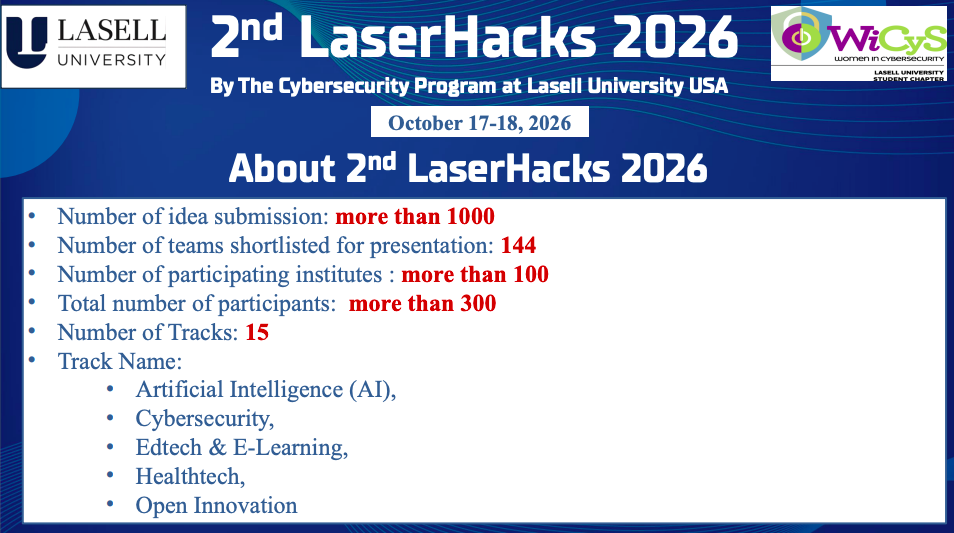
The hackathon received more than 1,000 idea submissions, shortlisted 144 teams for presentations and brought together over 300 participants representing more than 100 institutions. With 15 tracks spanning emerging and interdisciplinary technology areas, the event provided a platform for participants to present innovative ideas and demonstrate their technical and problem-solving capabilities.
The inaugural ceremony featured academic leaders from Lasell University and SCRS. Prof. Varshitha Manjunath, Assistant Professor and Cybersecurity Program Lead at Lasell University, welcomed participants. She also serves as the President of WiCyS Faculty Affiliate and as Secretary of the IEEE Boston Section 2026.
Prof. Sandeep Kumar, Professor at CHRIST University, Bengaluru, and Co-Convener of LaserHacks 2026, outlined the objectives of the hackathon and its role in encouraging students to develop technology-based solutions to contemporary challenges. Prof. Jagdish Chand Bansal, President of SCRS and Professor at South Asian University, New Delhi, introduced the society and its work in advancing research, innovation and collaboration in computing and emerging technologies. The opening ceremony concluded with a vote of thanks.
The programme covered Artificial Intelligence, Cybersecurity, EdTech and E-Learning, HealthTech, and Open Innovation. Participating teams explored a wide range of applications, including fraud detection, digital safety, intelligent healthcare, accessible education, sustainable agriculture, financial technology, autonomous systems and smart infrastructure. Projects were evaluated on their ideas, technical merit, feasibility and potential practical impact.
Industry and Academic Experts Evaluate Projects
LaserHacks 2026 featured multiple judging panels across its thematic tracks, bringing together professionals from technology companies, universities, research institutions and other organisations.
The Artificial Intelligence tracks were evaluated by Rohit Desai, Software Development Engineer ICT3 at Apple Inc.; Vamsi Viswanath Bethamsetty, Independent Researcher at the University of Florida, USA; Shubh Prabhat, Solution Architect at GlobalLogic, a Hitachi Group company; Mahendra Singh Rajput of Nokia; Amit Gupta, Senior Technical Lead at Concentrix; Poli Reddy Basani, Independent Researcher; Surajit Paul, Lead Platform Engineer at Stitch Fix; Rasmi Ranjan Choudhury, Chief Assistant Engineer; Harbhanu Sahai, Principal Software Engineer at Microsoft Corp.; Prathyusha Vasireddy, Solutions Engineer at Zpaper Inc.; Ketankumar Savajiyani, Independent Researcher based in New Jersey, USA; Taranath Pandit; and Manjeera Chanda, Senior MuleSoft Architect at GoodRx.
The Cybersecurity tracks featured Heta Patel, Senior SAP Developer at Doterra International LLC; Rengarajan Jegadeesan, Senior Software Engineer at Microsoft; Ugochukwu Anthony Igboko, Cyber Security Officer; Kumar Abhinav of AI-SD2; Anurag Dani of Carnegie Mellon University; Asha Kiran Ganesna, Lead Data Architect at General Mills; Avinash Kudipudi, Senior Network Security and Infrastructure Engineer at HealthPartners; Nikita Kothari of Salesforce; Prince Kumar, Principal Enterprise Architect and Portfolio Architect specialising in Enterprise Architecture and AI Governance; Abhishek Pandurang Benke, Occupational Health and Safety Officer; and Bharathi Sesha Sai Varanasi, Cybersecurity Architect at Leidos Inc.
The EdTech and E-Learning track was evaluated by Gagan Vyas, Member of Technical Staff at Everpure, and Vinod Rufus Motani, AI/ML Engineer. Projects in this category explored technology-enabled approaches to learning, accessibility, educational support and digital skill development.
The HealthTech track included Swapneswar Sundar Ray of U.S. Bank; Anup Dilip Kagalkar, Independent Researcher; and Chodisetti Ramakrishna, Solution Architect specialising in Cloud, AI and Blockchain. The track focused on technology-driven approaches to healthcare accessibility, medical assistance, patient support and related applications.
The Open Innovation tracks brought together judges from industry, academia and research. The panels included Sujan Kumar Reddy Challa, Independent Researcher; Neha Asthana of Abbott; Bhargav Krishna Korrapati of Gateway Solutions Inc.; Adya Mishra of IEEE; Neetu Uthaman, Independent Researcher; Anil Mandloi of Barkatullah Vishwavidyalaya, Bhopal; Rakshay Pawar, Senior Quantitative Finance Associate at Codeflow Capital LLC; Namratha Peddisetty, Individual Contributor; Niten Aggarwal of AT&T; Ranjith Rajasekharan, Senior Technical Specialist at Cognizant Technology Solutions US Corp.; and Isha Sharma, Program Manager at Medtronic MiniMed.
The diverse judging panels connected the hackathon’s technical evaluation with professional experience in software development, cybersecurity, enterprise architecture, data science, healthcare, finance and other application domains. Their participation provided a multidisciplinary perspective on the projects presented by the teams.
Encouraging Innovation Across Emerging Technologies
By combining a virtual format with multidisciplinary tracks and expert evaluation, LaserHacks 2026 offered participants an opportunity to test their ideas, present technical solutions and engage with experienced professionals. The event underscored the importance of collaborative innovation in addressing challenges across artificial intelligence, cybersecurity, education, healthcare and other sectors. The Adaption AI Challenge, an integral component of the hackathon, will continue until 25 October 2026, giving participants additional time to develop, refine, and showcase their AI-driven solutions beyond the main hackathon event. Through the collaboration between Lasell University’s Cybersecurity Program, the WiCyS Lasell Student Chapter and the Soft Computing Research Society, LaserHacks 2026 strengthened the connection between student innovation, academic engagement and industry-oriented problem-solving.
Photographs of the are available at the following Google Drive link: LaserHacks 2026 Photographs