.png)
The 5th International Conference on Advances in Data-driven Computing and Intelligent Systems (ADCIS 2026) concluded successfully on October 9–10, bringing together researchers, academicians, and industry professionals from across the world. Organised by the Soft Computing Research Society (SCRS), New Delhi, in academic partnership with Malaviya National Institute of Technology Jaipur (MNIT Jaipur), the conference was conducted in hybrid mode, enabling participation through both physical and online platforms.
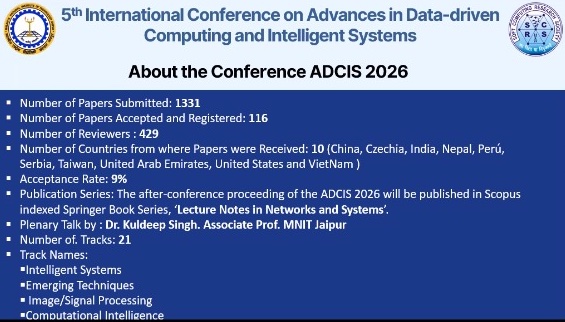
The conference received 1,331 research paper submissions from 10 countries, including China, Czechia, India, Nepal, Peru, Serbia, Taiwan, the United Arab Emirates, the United States, and Vietnam. Following a rigorous peer-review process involving 429 reviewers, 116 papers were accepted and registered, resulting in an acceptance rate of approximately 9%. The accepted contributions were presented across 21 technical sessions covering four major research tracks: Intelligent Systems, Emerging Techniques, Image/Signal Processing, and Computational Intelligence.
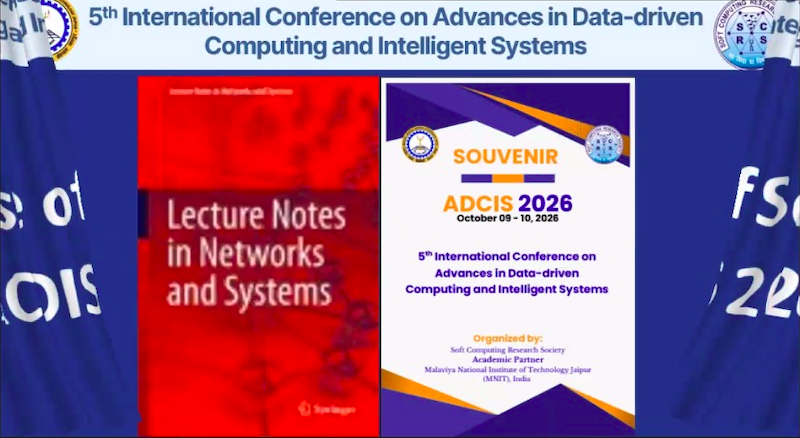
The inaugural ceremony on October 9 opened with a welcome address by Prof. Rajesh Kumar, General Chair of ADCIS 2026. Dr. Chandra Prakash, Head of the Department of Artificial Intelligence and Data Engineering (AIDE), MNIT Jaipur, introduced the department and its academic activities. Dr. Ashish Tripathi, General Chair of the conference, outlined its objectives and research focus, while Prof. Jagdish Chand Bansal, President of the Soft Computing Research Society, highlighted the importance of research collaboration and innovation in computing and intelligent systems. The conference souvenir was released during the ceremony, followed by an address from the chief guest, Prof. Rohit Bhakar, Dean (Research and Consultancy), MNIT Jaipur. Dr. Kuldeep Singh, Associate Professor at MNIT Jaipur, delivered the plenary talk, sharing insights relevant to machine learning, deep learning, computer vision, and intelligent applications.
A key highlight of ADCIS 2026 was the keynote address by Dr. Kaviya Elakkiya of UCSI University, Kuala Lumpur, Malaysia. Her talk, titled “Towards Objective Diagnosis in Healthcare Utilizing Machine Learning and Deep Learning,” explored the role of advanced computational techniques in healthcare and diagnostic decision-making. The address underscored the potential of AI-driven approaches to support objective diagnosis and improve data-driven healthcare solutions.
The conference also featured invited talks by experts from prominent technology organisations and research institutions. The invited speakers included Anurag Dani of Carnegie Mellon University; Akhilesh Chaganti, Staff Software Engineer at IBM; Isha Sharma, Product Development Project Specialist at MiniMed; Niten Aggarwal of AT&T; Vijaya Bhaskar Reddy Saadhu, Senior ERP Solution Architect in Mississippi, USA; and Chandramouli Holigi of General Motors. Their talks addressed emerging topics such as data systems and object storage, AI adoption in regulated healthcare, enterprise resource planning, traffic-aware autoscaling of enterprise microservices, and security, trust, and governance for enterprise AI agents. These discussions highlighted the growing significance of scalable infrastructure, responsible AI implementation, and intelligent enterprise solutions.
The technical sessions were supported by professionals from leading technology companies and independent research backgrounds. The session chairs for the Emerging Technology area included Ashwin Krishnappa Kumar of Tesla; Prasad Hirekerur, Senior Data Engineer at PenFed Credit Union; Ketankumar Savajiyani, Independent Researcher based in New Jersey, USA; Amit Gupta, Senior Lead Software Engineer at Concentrix; Spurthi Tallam of LePrix; Senthil Kumar Muthu, Senior Principal Engineer at Nordstrom, USA; Rameshkumar Varanganti, Independent Researcher; Satyanarayana Gadiaju, Independent Researcher; and Saurabh Sagar of Walmart. Their involvement helped facilitate technical discussions and encouraged interaction between academic research and industry experience.
Across its technical sessions, ADCIS 2026 provided a platform for presenting advances in artificial intelligence, data-driven methodologies, image and signal processing, optimisation, and intelligent systems. The hybrid format broadened participation and enabled researchers and professionals to exchange ideas on emerging computational approaches and their practical applications across different sectors.
The post-conference proceedings are scheduled for publication in the Scopus-indexed Springer book series Lecture Notes in Networks and Systems, offering an avenue for disseminating accepted research contributions to the wider scientific community.
By bringing together international researchers, academic leaders, and industry experts, ADCIS 2026 reinforced the importance of interdisciplinary collaboration and knowledge exchange in advancing artificial intelligence, data science, and intelligent computing. The conference concluded with a focus on strengthening research partnerships and promoting innovative computational solutions to contemporary scientific and industrial challenges. For further information, visit https://www.scrs.in/conference/adcis2026.
Photographs of the are available at the following Google Drive link: ADCIS2026 Photographs