.png)
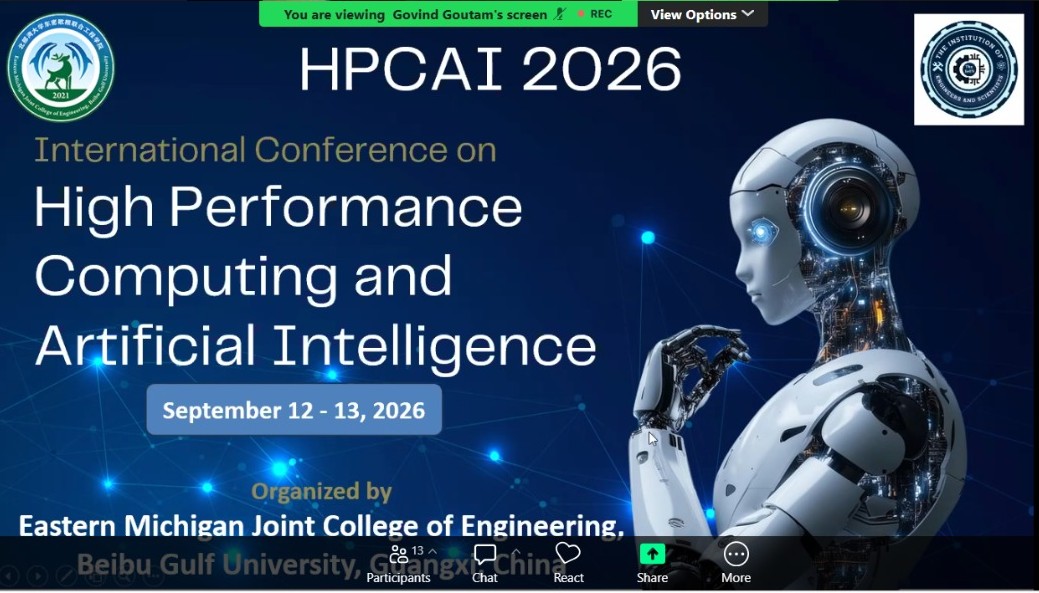
The International Conference on High Performance Computing and Artificial Intelligence (HPCAI 2026) concluded successfully after two days of extensive technical discussions, research presentations and expert interactions on the future of high-performance computing (HPC), Artificial Intelligence (AI) and intelligent computing systems. Held on September 12–13, the international conference brought together researchers, academicians, industry professionals and technology experts from across the world.
The conference was organised by the Eastern Michigan Joint College of Engineering, Beibu Gulf University, Guangxi, China, with The Institution of Engineers and Scientists (The IoES) serving as the technical sponsor. The event focused on the growing convergence of high-performance computing and AI and examined how advanced computational technologies can be transformed into scalable, secure, reliable and responsible solutions for real-world applications.
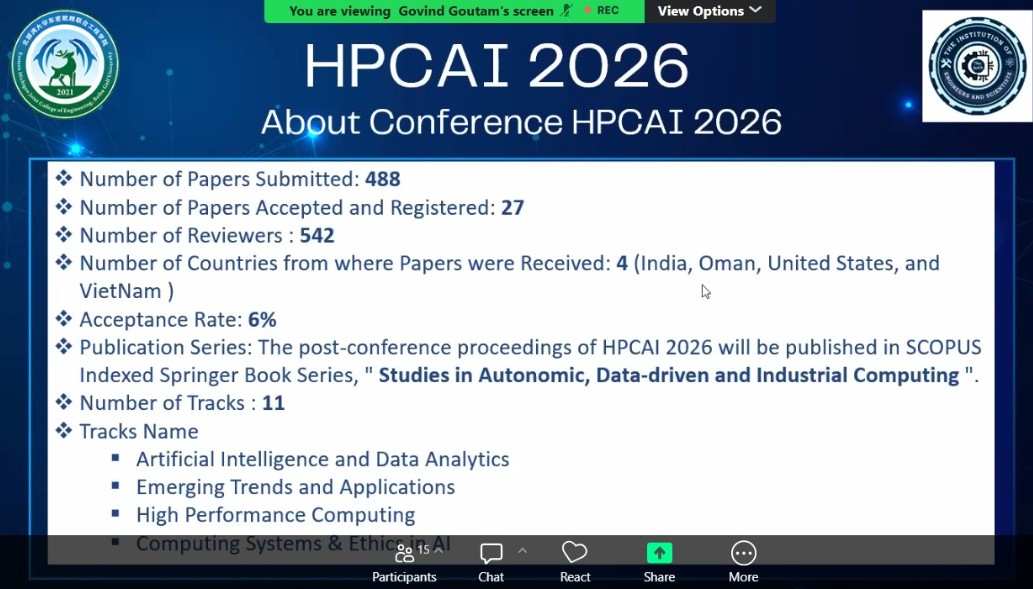
The scale and selectivity of the research programme reflected the growing global interest in the field. HPCAI 2026 received 488 research paper submissions, of which only 27 papers were accepted and registered, resulting in an acceptance rate of approximately 6 per cent. The submissions came from India, Oman, the United States and Vietnam and were evaluated with the support of 542 reviewers. The accepted papers were presented across 11 technical tracks covering Artificial Intelligence and Data Analytics, Emerging Trends and Applications, High Performance Computing, and Computing Systems & Ethics in AI.
The conference opened with a welcome address by Dr. Nallappan Gunasekaran, General Chair, HPCAI 2026, who introduced the Eastern Michigan Joint College of Engineering at Beibu Gulf University, Guangxi, China. Dr. Gaurav Gupta, General Chair, HPCAI 2026, presented an overview of the conference and its objectives. Prof. Mukesh Saraswat, Chair, The Institution of Engineers and Scientists, highlighted the role of the IoES in promoting engineering, scientific research and technological collaboration.
A key feature of the conference was its keynote programme, which brought together experts working across enterprise technology, AI, cybersecurity, data science and emerging computing. The keynote speakers were Naveen Vaduguru, SAP Data & Analytics Consultant and Independent Researcher; Anushka Rodi, Independent Researcher and Personal Lines Insurance Technical Analyst; Deepak Saxena, Director Data Science & AI, TWG AI; Suresh Kumar Ganapathy, Security Engineering Manager, Truist; Kuljeet Kaur, Independent Researcher; and Utpal Das, Senior IT Technical Lead, KnitWell Group, Columbus, Ohio, USA.
The keynote presentations addressed some of the most pressing issues emerging with the rapid adoption of AI. Anushka Rodi discussed “Proving Compliance, Not Explaining It: Neurosymbolic Governance for Multi-State AI Underwriting Systems,” focusing on compliance and governance in AI-enabled insurance systems. Deepak Saxena explored the development of multi-agent systems for real-world enterprise workflows, highlighting the move from individual AI agents towards coordinated intelligent systems. Suresh Kumar Ganapathy addressed cybersecurity through “Securing MCP: A Zero-Trust Framework for Agentic AI,” while Kuljeet Kaur examined how human–AI collaboration could reshape work in the coming years. Utpal Das discussed edge intelligence and AI for next-generation fulfillment in federated multi-brand retail ecosystems, connecting AI with distributed retail operations and fulfillment.
The invited-speaker programme added an industry-focused dimension to the technical deliberations. Somesh Nagalla, Sr. Software Engineer, 7-Eleven, delivered a talk titled “Infrastructure That Heals, Saves, and Protects: A Research Program for Trustworthy AI Systems at Cloud Scale.” His presentation examined the infrastructure requirements for deploying dependable and trustworthy AI systems at cloud scale and highlighted the importance of resilience, reliability and trust as AI applications move into large-scale production environments.
The conference's technical sessions were conducted with the support of experts from academia, research and industry. The session chairs included Sai Pavan Gopularam, Ramesh Kumar Varanganti, Jay Dave, Sashank Siwakoti, Aniket Kelkar, Chiranjevi Sai Venkat Kaushik Dhulipudi, Bilal Saiyad, Priyank Jain, Bhanu Singh, Sowmya Varakala, Siddharth Arun, Jitender Sahu, Shivam Gupta, Animesh Dhole, Ajay Upadhyay, Darshil Dhameliya, VenkateswaraReddy Gudise, Mrugesh Kharwar, Shanmugasharma Vijayarangan, Snehal Sharad Godse, Raghu Chirra, Mayank Sethi, Rohith Venkata Sai Kumar Potladurthy, Deep Barot, Leslie Daniel Raj, Janvi Saddi, Aditya Rautaray, Durga Prasad Dasepalli, Sanmesh Sankhe, Shivani Managari, Suprajyotsna Dasari, Akshay Ramachandran and Poli Reddy Basani.
The
technical programme covered a wide range of subjects at the intersection of advanced computing and AI. Discussions included parallel and distributed
computing, GPU and heterogeneous computing, exascale computing, performance optimisation, distributed deep learning, cloud-based HPC, edge AI, machine
learning, explainable and trustworthy AI, evolutionary and swarm intelligence, data analytics, privacy-preserving machine learning, cybersecurity, ethical AI, quantum computing, digital twins and AI for scientific discovery.
HPCAI 2026 also facilitated interaction among professionals from diverse disciplines, including computer science, artificial intelligence, mathematics, software
engineering, cybersecurity, data science, enterprise architecture, healthcare, insurance and retail. The combination of academic research and industry
experience provided participants with opportunities to understand practical challenges and identify possibilities for future collaboration.
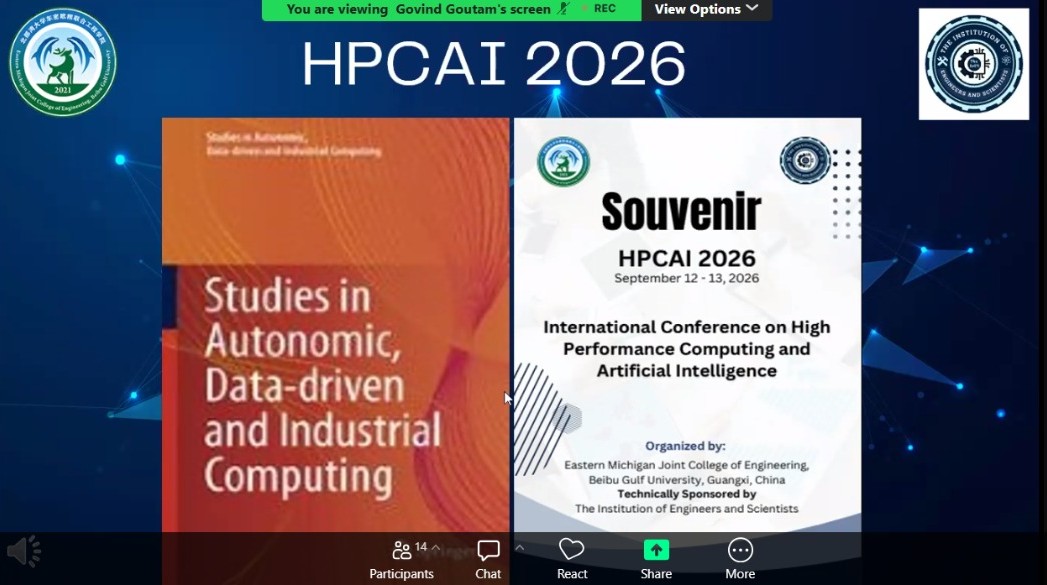
Adding further value to the research outcomes, the post-conference proceedings are planned for publication in the SCOPUS-indexed Springer Book Series, Studies in Autonomic, Data-driven and Industrial Computing. This is expected to provide wider dissemination of selected research contributions presented at the conference.
The two-day event concluded with a strong emphasis on the evolving relationship between computing infrastructure and intelligent technologies. The discussions highlighted that the next generation of AI systems will require not only advanced algorithms and models but also scalable infrastructure, resilient architectures, secure data environments, responsible governance and meaningful human–AI collaboration.
With its selective research programme, international participation and strong representation from academia and industry, HPCAI 2026 provided a significant platform for global knowledge exchange in high-performance computing and Artificial Intelligence, while encouraging continued research and collaboration towards intelligent technologies that are secure, trustworthy, sustainable and capable of delivering meaningful impact across science, industry and society.
Photographs of the conference are available at the following Google Drive link: HPCAI Photographs