The telecommunications industry faces unprecedented pressure. Customers
demand personalized experience while profit margins continue to shrink. Too
many companies still rely on mass marketing campaigns. They wait for customers
to complain before acting. This reactive approach no longer works in today's
competitive landscape.
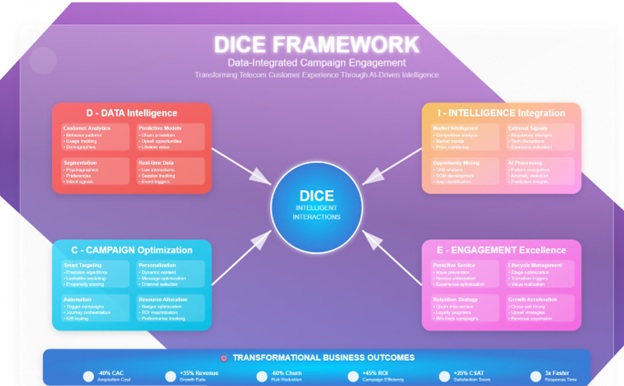
The solution lies in the DICE framework: Data-Integrated Campaign
Engagement. This isn't just another analytics tool. It represents a fundamental
shift from guessing what customers want to know what they need before they
realize it themselves.
Why Traditional Methods Fall Short
Most telecom companies operate in reactive mode. They segment customers
using basic demographics. They send generic campaigns across broad audiences.
Then they wonder why response rates remain disappointingly low. When customers
finally call to cancel, teams scramble with retention offers that should have
been deployed months earlier.
The DICE framework reverses this pattern entirely. Instead of reacting to
problems, it predicts and prevents them. Rather than running broad campaigns
that waste the budget, it enables precise targeting that actually converts.
Most importantly, it transforms scattered customer data into actionable
intelligence. This intelligence expands your Total Addressable Market while
optimizing your Serviceable Obtainable Market.
The Four Components That Drive Results
Customer Intelligence
This component goes far deeper than typical CRM data. It combines
demographics and usage patterns with behavioral analytics. These analytics
reveal churn risk and identify upsell opportunities. When you understand not
just what customers do, but why they do it, you can create engagement
strategies. These strategies feel personal rather than pushy.
Competitive Intelligence
This provides essential market context that most companies ignore. The
framework analyzes competitor offerings, pricing strategies, and market
positioning. This analysis isn't about matching prices. It's about finding
differentiation opportunities that competitors cannot easily replicate.
Market Signals
These capture broader trends affecting your industry. Regulatory changes,
technology disruptions, and emerging customer behaviors all generate important
signals. Most companies react to these changes after they've already damaged
revenue. The DICE framework helps you position proactively instead of
scrambling to catch up.
Augmented Criteria
These add psychological and behavioral layers that traditional
segmentation misses. Psychographics, intent signals, geographic nuances, and
channel preferences all contribute valuable insights. This granular
understanding lets you customize campaigns. These campaigns align with how
individual customers actually prefer to communicate.
Building Markets Through Strategic
Data Application
The DICE approach to market development differs significantly from
typical segmentation methods. TAM definition combines macro-level market data
with competitive intelligence. This combination identifies genuine
opportunities rather than wishful thinking about market size. The process
examines current conditions and future growth potential. This creates realistic
strategic plans grounded in data.
Moving from analysis to action, SOM development focuses on achievable segments. It considers customer fit, readiness, and accessibility factors. This prevents the common mistake of chasing unrealistic opportunities. Meanwhile, high-probability prospects often sit right in front of you, overlooked. Campaign design then leverages these insights effectively. It creates messaging that speaks directly to specific segment needs instead of relying on generic value propositions.
Implementation That Delivers Results
Foundation Building
Getting DICE operational requires comprehensive data aggregation. This
includes internal CRM, billing, and usage systems. It also incorporates
external market research and competitive intelligence. This unified foundation
provides the complete customer view needed for intelligent interactions. It
simultaneously offers market context for strategic positioning decisions.
Advanced Analytics Integration
Advanced analytics transform raw data into actionable insights.
Segmentation algorithms and predictive modeling drive this transformation.
Machine learning identifies behavioral patterns that manual analysis typically
misses. This enables accurate churn prediction, lifetime value estimation, and
cross-sell opportunity identification.
Continuous Optimization
Real-time tracking and feedback loops maintain campaign optimization
throughout execution. AI and machine learning enable predictive targeting that
improves continuously. This maximizes ROI while reducing waste on ineffective
strategies.
Measurable Business Impact
The DICE framework delivers quantifiable improvements across key business
metrics. These improvements transform operational efficiency and financial
performance.
Cost Reduction: Promotional spending drops through precisely targeted campaigns.
Resources focus on receptive segments instead of spray-and-pray approaches.
Real-time optimization enables dynamic resource reallocation when strategies
underperform.
Acquisition Efficiency: Customer acquisition costs decrease when market intelligence enables
precise targeting. The framework identifies prospects most likely to convert
and remain loyal. This targeted approach significantly improves conversion
rates and customer lifetime value.
Revenue Growth: Revenue optimization comes from enhanced cross-sell and upsell success.
Behavioral analytics and timing optimization drive these improvements.
Understanding individual customer lifecycle stages helps identify optimal
moments for introducing additional services.
Retention Improvement: Churn reduction improves through proactive retention strategies. These
strategies are informed by predictive analytics and competitive intelligence.
Instead of generic retention offers, DICE enables personalized interventions.
These interventions address specific customer concerns while highlighting
unique value propositions competitors cannot match.
Overcoming Implementation Challenges:
Practical Approaches
While DICE deployment presents significant hurdles, proven strategies can
ensure successful implementation.
Data Integration Solutions
Challenge: Legacy systems often prevent comprehensive data aggregation across
disparate sources.
Solution: Start with a phased approach to Customer Data Platform implementation.
Begin by connecting your highest-value data sources first. Establish data
quality standards early and invest in automated cleansing tools. Partner with
experienced systems integrators who understand telecom-specific data
challenges. Create cross-functional teams that include IT, marketing, and
operations from day one.
Analytical Capability Development
Challenge: Moving beyond basic reporting requires advanced machine learning and
predictive analytics capabilities.
Solution: Build a hybrid talent strategy combining internal development with
external partnerships. Hire data scientists with telecom industry experience.
Establish centers of excellence that can scale analytical capabilities across
business units. Invest in cloud-based analytics platforms that reduce
infrastructure complexity. Create clear career paths for analytical talent to
improve retention.
Cultural Transformation Management
Challenge: Shifting from intuition-based decisions to evidence-driven customer
engagement represents the biggest organizational hurdle.
Solution: Secure visible executive sponsorship and participation in DICE
initiatives. Start with pilot programs that demonstrate quick wins to build
organizational momentum. Establish clear metrics and dashboards that make
data-driven insights accessible to all stakeholders. Implement comprehensive
training programs that build data literacy across the organization. Create
incentive structures that reward data-driven decision making. Celebrate and
communicate success stories to reinforce cultural change.
The Competitive Advantage
Organizations that master DICE gain sustainable competitive advantages in
increasingly commoditized markets. The ability to anticipate customer needs,
deliver personalized experiences, and optimize resource allocation creates
differentiation. Traditional competitors struggle to replicate this
comprehensive approach.
Furthermore, market responsiveness improves dramatically through the
framework's market signals component. This enables proactive positioning for
industry changes rather than reactive responses. Customer loyalty increases
through personalized engagement strategies that demonstrate deep understanding
of individual needs. These strategies create stronger emotional connections
that transcend simple service delivery.
Looking Forward
The DICE framework establishes the foundation for next-generation
customer experience strategies. These strategies will define competitive
success in the evolving telecommunications landscape. As AI capabilities
advance and customer expectations continue to evolve, organizations mastering
data-integrated campaign engagement will establish sustainable advantages.
Meanwhile, competitors relying on traditional approaches will face increasing
market pressure.
Intelligent interactions through DICE represent more than operational
improvement. They represent strategic transformation that turns customer
relationships into competitive advantages. They convert market intelligence
into profitable growth opportunities that drive long-term business success.
Hemant Soni