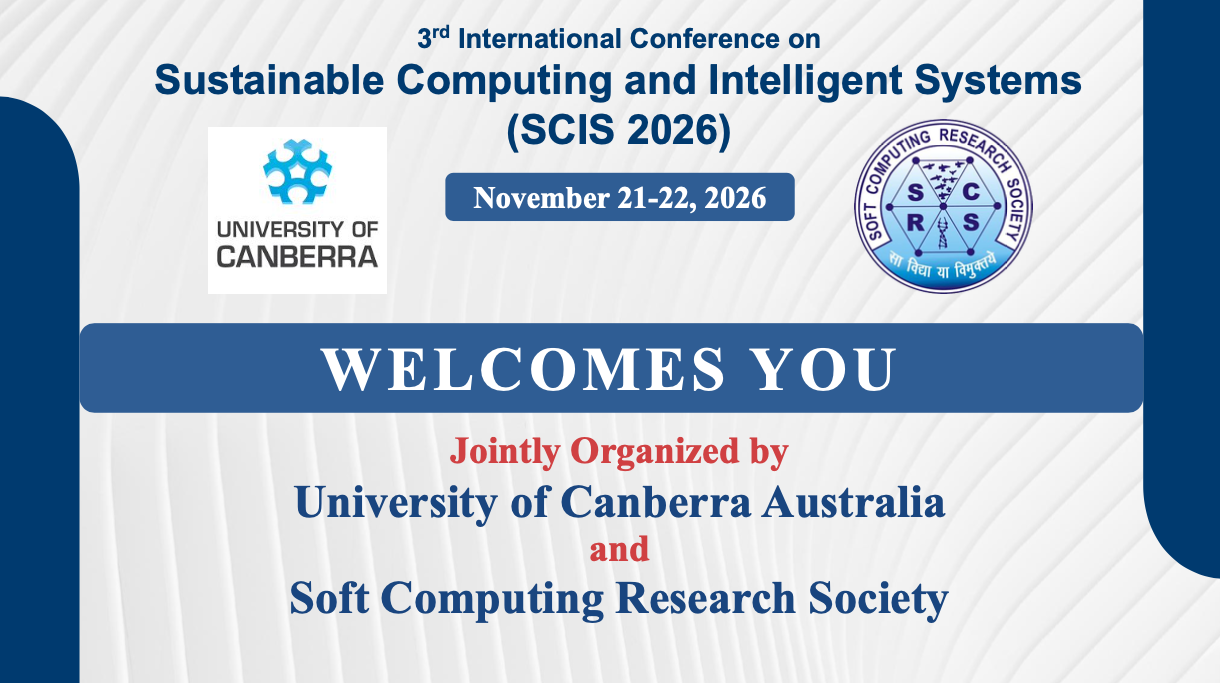
The third International Conference on Sustainable Computing and Intelligent Systems (SCIS 2026) concluded on November 22 after two days of academic discussions and research presentations involving participants from 12 countries. The conference was jointly organised by the University of Canberra, Australia, and the Soft Computing Research Society (SCRS) on November 21 and 22, 2026.
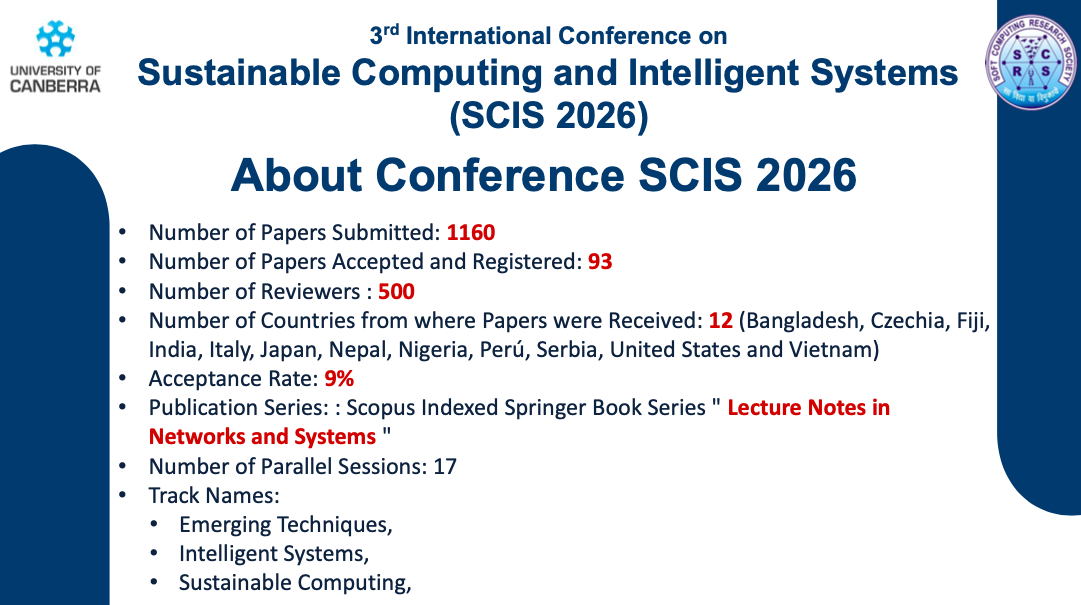
The conference attracted 1,160 research paper submissions from Bangladesh, Czechia, Fiji, India, Italy, Japan, Nepal, Nigeria, Peru, Serbia, the United States and Vietnam. Following a review process involving 500 reviewers, 92 papers were accepted and registered, resulting in an acceptance rate of approximately 8 percent. The accepted papers were presented across 17 parallel sessions.
The technical programme was divided into three main tracks: Emerging Techniques, Intelligent Systems and Sustainable Computing. Researchers presented their work on a range of subjects, including data science, machine learning, cybersecurity, energy-efficient computing, healthcare applications, intelligent automation and emerging computational methods.
The opening ceremony began with a welcome address by Prof. Prashant Jamwal of Nazarbayev University, Kazakhstan, who was the General Chair of the conference. Prof. Harish Sharma, General Secretary of SCRS and Organising Chair, introduced the activities of the Soft Computing Research Society. The conference souvenir was released during the ceremony, which concluded with a vote of thanks.
The conference brought together keynote speakers from universities and organisations across different countries. The keynote speaker list included Jagan Ankam of CGI Technologies and Solutions Inc.; Anurag Dani, Independent Researcher, Sunnyvale, California; Sakthi Sankara Balaji Sathyamurthy, Independent Scholar, Atlanta, Georgia; Kamana Parvej of Trine University; Mohammed Muqthar Ghori of Intellectt Inc.; Muhammad Zeeshan of Media Mind Management LLC, USA; Sandeep Ayloo of Walmart Global Tech; Rameshkumar Varanganti, Independent Researcher and Enterprise Application Integration Architect; Sachin Gupta of eBay; Anshul Vyas of Turo; and Indrajit Suresh Zope, Senior Solutions Architect.
The invited speaker programme featured professionals from several technology companies and research backgrounds. These included Viswatej Kasapu of NVIDIA Corporation, Mounika Lakka of UnitedHealth Group, Divyanshu Abhichandani of Harvey AI, Prateik Mahendra of Hinge Health, Rasik Borkar of Visa, Vivek Bagmar of Arista Networks, Pareshkumar Gandhi of Amazon, Niveditha Ramagopalan of Citibank, Kumar Abhinav of AiDash, Asha Kiran Ganesna of General Mills, Niten Aggarwal of AT&T, Saddam Hussain, Data Scientist and Independent Researcher in the United States, and Cinibia Varghese, Senior Data Solutions Architect and Independent Data and Technology Professional.
The programme also involved experts from academic institutions and industry who chaired the technical sessions. They included Nazir Mohammed of ASP Web Solutions LLC; Surajit Paul of Stitch Fix; Anurag Dani of Carnegie Mellon University; Sai Teja Ranga of the New Jersey Department of Environmental Protection; Saidul Islam of Washington University of Science and Technology; Venkata Swamy Madasi of Mphasis; Obede Bessa Rocha da Silva of Instituto Infnet, Brazil; Muhammad Zeeshan of the University of Gujrat; Srikumar Nayak of the State of Alabama; Venudhar Hajari of Smith+Nephew and Chair of the ASQ Austin Chapter; Manjeera Chanda of GoodRx; Sailaja Songa of Texas Tech University; Prabhu Sivapunniyam of Salesforce; and Raja Kumara Swamy Donthula, Independent Researcher, USA.
Discussions during the conference addressed the application of intelligent computing in areas such as healthcare, finance, manufacturing, agriculture, cybersecurity and enterprise systems. Presentations also covered sustainable computing practices, data-driven technologies, privacy, digital infrastructure and methods for improving the efficiency and reliability of computing systems.
The conference offered researchers an opportunity to present their findings, interact with fellow researchers and receive feedback on their work. Participation by professionals from industry also brought practical perspectives to discussions on current research problems and technology applications.
The selected papers from SCIS 2026 are scheduled to be submitted for publication in Springer's Scopus-indexed book series, Lecture Notes in Networks and Systems (LNNS), subject to the publisher's review and acceptance.
With 1,160 submissions and participation from 12 countries, SCIS 2026 provided a common platform for academic and professional exchange in sustainable computing and intelligent systems. The conference concluded with a focus on further research collaboration and the development of solutions to contemporary challenges in computing and technology.
Photographs of the event are available at the following Google Drive link: SCIS 2026 Photographs