.png)
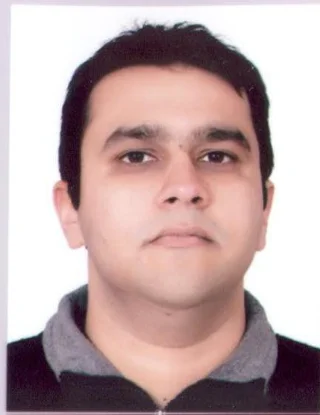
Dr. Shahid Hussain, University of Canberra, Australia
Dr. Hussain is working at University of Canberra as Associate Professor of Biomedical Robotics. Prior to that he has worked as lecturer at University of Wollongong, Australia. Dr. Hussain has obtained his PhD in Mechanical Engineering from the University of Auckland, New Zealand in 2013. His research interests include assistive and rehabilitation robotics, compliant actuation of robots, robot mechanism design and optimization, non-linear dynamics and control of robotic systems, human-robot interaction, biomechanical modelling, engineering education and micro electro-mechanical systems (MEMS). Dr. Hussain has published more than 70 papers in the prestigious journals of the field.
In discussion with: Dr. Jagdish Chand Bansal
Title:
Biomedical Robotics: The Next Big Leap in Healthcare
“Dr. Shahid Hussain, University of
Canberra, Australia, in discussion with Dr. Jagdish Chand Bansal, South Asian
University, India.”
Dr. Jagdish Chand Bansal:
I am Dr. Jagdish Chand Bansal from South Asian University.
Dr. Shahid Hussain: Yes.
Dr. Jagdish Chand Bansal: This discussion will be uploaded to the Soft
Computing Research Society's (SCRS) tech magazine SCRS Insights and will
focus on you, your research, and future perspectives. Let’s start—tell me about
yourself.
Dr. Shahid Hussain:
Yes.
My name is Shahid Hussain, and I am an
associate professor of biomedical robotics at the University of Canberra,
located in the Australian Capital Territory. I started as an assistant
professor and have been working here since 2018.
Before that, I was a lecturer in
mechatronics at the University of Wollongong, Australia, for nearly two and a
half years. Prior to that, I was an assistant professor at Nazarbayev University
in Kazakhstan. I completed my PhD in medical robotics, specifically
rehabilitation robotics, from the University of Auckland, New Zealand, in 2013.
I also earned my master’s degree in robotics from the University of Auckland in
2009 and my Bachelor of Engineering (Honors) in mechanical engineering with a
specialization in mechatronics from the University of Engineering and
Technology, Lahore, Pakistan, in 2007.
I have been involved in full-time
research and academia since July–August 2013, making it roughly 12 years now.
My work focuses on biomedical and rehabilitation robotics, and I lead a
research group in this domain, which includes five PhD students and a research
fellow. I will discuss collaborations and multidisciplinary research later.
That’s basically my journey.
Dr. Jagdish Chand Bansal:
What a diverse experience you have—Kazakhstan, Lahore, Australia, mechanical
engineering, mechatronics, and then robotics.
Dr. Shahid Hussain: Yes.
Dr. Shahid Hussain: Yes. My experiences have been mostly positive. As an
undergraduate, it was highly competitive—similar to admission into IITs in
India. The ranking and selection process were highly competitive because the
university admitted only students with the highest grades or GPA in the
country. It was a great experience. During my fourth year of undergraduate
engineering, I worked on biomedical robotic systems, which led to a PhD
scholarship offer from the University of Auckland, New Zealand.
New Zealand had a highly international
student environment, especially in the Faculty of Engineering, where the
majority were international students. I gained valuable experience working with
them, learning about their cultures, and sharing diverse perspectives. It was a
fascinating experience as an international student.
When I started my first academic job in
Kazakhstan, I didn’t feel much of a difference because the university was newly
established, and I was involved in significant lab development. My work is
heavily lab-based—I build robots from scratch rather than purchasing
off-the-shelf models.
Dr. Jagdish Chand Bansal: Thanks.
Dr. Shahid Hussain: So that was a big task at a new
university. So I was also a part of writing their new curriculum for
undergraduate degrees. I also wrote the curriculum for their PhD degrees like
the coursework for PhD which the students do.
Setting up labs at a new university was a major task. I was also responsible for
designing the undergraduate and PhD curricula, including coursework for PhD
students. The university followed a Western-style education model, which was
familiar to me since I studied in Pakistan and New Zealand—both of which follow
a British-style education system
I wrote that curriculum. I
established the labs there as well. So that university was built on the model
of western style education and since I come from a part of the world. which was once a British colony.
So our system was quite similar to what I have been through and I went to New
Zealand.
Dr. Jagdish Chand Bansal: Yes, we have common friend also
in Najar University
Dr.
Shahid Hussain :- Prashant followed me , A
friend, who was previously a full professor at Rajasthan Technical University
and my senior during my PhD, later joined me in Kazakhstan. I had gained
valuable experience there and convinced him to come as well. He arrived a year
after me, and after I left for Australia, he continued there.
Since my education was primarily in New
Zealand and Pakistan under a UK-style university system, transitioning to
Australia was smooth. The Australian university system closely resembles that
of the UK and New Zealand, so I faced no difficulties adjusting to job
requirements.
At that point, I began developing a new
undergraduate biomedical engineering program as a lecturer at the University of
Wollongong. This four-year Bachelor of Engineering (Honors) program focused on
medical devices—both implantable (such as stents and heart valves) and non-implantable
(such as robotic prosthetics, robotic orthoses for rehabilitation, and surgical
robots). The program was designed around the theme of medical device
development.
Dr. Jagdish Chand Bansal:
Actually, this is another area of interest I read about in your
publications—biomedical robotics. Can you tell me what biomedical robotics is
and how it differs from ordinary robotics?
Dr. Shahid Hussain:
Ordinary robotics started in the 1940s and ’50s during the second and third
industrial revolutions. In the 1970s and ’80s, during the third industrial
revolution, traditional robots were primarily used for tasks like
pick-and-place operations in automobile assembly plants. Later, robotic
manipulators began performing tasks such as welding and spray painting in the
automobile industry.
Dr. Jagdish Chand Bansal:
That’s okay.
Dr. Shahid Hussain:
These industrial robots did not consider human interaction. If a human operator
tried to make changes, the robots were rigid and unresponsive. Their functions
were fixed and could not be altered.
Dr. Jagdish Chand Bansal:
You mean they were more mechanical and less intelligent?
Dr. Shahid Hussain:
Yes, they were very mechanical and rigid. That was the nature of industrial
robotic systems.
When we switch to biomedical robotics,
these systems must interact with the human body, which presents a greater
challenge. For example, if a person loses a limb due to a landmine or accident
and requires a robotic prosthesis, the challenge lies in customization. Every
person’s walking pattern is unique. With 7–8 billion people in the world, each
has a different gait. We must adapt rigid industrial robotic systems,
originally designed for tasks like welding and painting, to accommodate the
individual needs of each patient.
Another example is designing robots for
physiotherapy, particularly for stroke patients. Each stroke is different, and
the nature of the resulting disability varies. Even for the same patient, after
six to seven weeks of recovery, limb movement and capabilities improve or change.
A single robotic system must be able to adapt to the individual disability
level of each patient.
Because if we impose industrial robots
with the same pattern and forces on the patient's limb during physical therapy,
it won't help in recovery. That is the key difference. The shift in biomedical
robotics from industrial robotics is toward accommodating injuries and
personalizing robots to meet individual needs.
Dr. Shahid Hussain:
Industrial robots lack adaptability and personalization for each human subject,
whereas biomedical robotics focuses on safety.
Dr. Jagdish Chand Bansal:
Yes.
Dr. Shahid Hussain:
These robots interact directly with the human body, so they must be extremely
safe. Safety is a crucial design consideration in biomedical robotics, along
with how the robot interacts with the human body. This falls under human-robot
interaction, which is very different from traditional industrial robotics. The
challenge is designing robots that adapt their assistance and applied forces to
individual needs.
Dr. Shahid Hussain:
This is a significant and complex task. Most current research focuses on safety
and interaction with patients and human subjects. That is the major distinction
between biomedical and industrial robots. For industrial robots, size and
weight are not critical concerns, but for biomedical robots, they are essential
because they must attach to the human limb.
Dr. Jagdish Chand Bansal:
Okay. Yes.
Dr. Shahid Hussain:
So, considering the size and weight of biomedical robots is crucial.
Dr. Jagdish Chand Bansal:
I was making an analogy with a news report I read in Spectrum a few years ago
about small swarm robots injected into the human body to perform cancer surgery
from the inside.
Dr. Shahid Hussain:
Yes.
Dr. Jagdish Chand Bansal:
Is that technology practical?
Dr. Shahid Hussain: Researchers in the
US and Australia are actively working on it. Injectable robots for surgical
purposes are being developed, though they are not yet commercially available.
Dr. Shahid Hussain:
A group at Wollongong University, where I previously worked, was led by a
senior professor who designed a robotic capsule.
Dr. Jagdish Chand Bansal:
Okay.
Dr. Shahid Hussain:
Diabetic patients and others who need regular medication can benefit from
targeted drug delivery.
Dr. Shahid Hussain:
The idea was to achieve targeted drug release based on location and time. He
was developing a robotic capsule that, once ingested, would stay in the body
for a few days, releasing the drug as needed.
Dr. Jagdish Chand Bansal:
And it adjusts insulin according to the body's requirements.
Dr. Shahid Hussain:
Yes, the targeted drug delivery can also be remotely controlled via a phone
application. After the drug is fully released, the capsule either dissolves or
exits the body. He obtained a Hong Kong or Singapore patent for this
innovation.
Dr. Shahid Hussain:
He conducted extensive research, but the challenge lies with drug
administration bodies. Organizations like the FDA in the USA and the
Therapeutic Goods Administration have strict safety and clinical trial
protocols.
Dr. Jagdish Chand Bansal:
Yes, that’s a challenge.
Dr. Shahid Hussain:
Injectable robotic micro-robots must undergo rigorous testing and evaluation
before commercialization. However, robotic prosthetics are more commonly used,
especially for patients who have lost limbs due to accidents or landmines.
Dr. Shahid Hussain:
Many U.S. companies have developed robotic prosthetics for soldiers injured in
Vietnam, Afghanistan, and Iraq. These include lower and upper limb prosthetics.
Additionally, commercially available rehabilitation robots assist stroke and
spinal cord injury patients in physiotherapy, as they are external and easier
to regulate in terms of safety.
Dr. Jagdish Chand Bansal:
Yes, I was saying…
Dr. Shahid Hussain:
Managing safety for external robots is simpler, but ingestible or injectable
robots require extensive research and testing before commercial use.
Dr. Jagdish Chand Bansal:
This is an exciting technology with tremendous growth potential.
Dr. Shahid Hussain:
Absolutely.
Dr. Jagdish Chand Bansal:
Biomedical rehabilitation robotics is significantly improving human lives. In
my opinion, advancing technology to benefit humanity should be the primary goal
of any scientist.
Dr. Shahid Hussain:
I completely agree.
Dr. Jagdish Chand Bansal:
That's great that you are helping humankind in this. Where?
Dr. Shahid Hussain:
In the Western world and also in developing countries, this is becoming a
significant problem. We have a rapidly aging population, and you may have
noticed in your own community that people often struggle to get up from a
wheelchair or bed, or even walk, once they are above 65.
We are developing robotic exoskeletons
for elderly assistance. Modern research shows that staying physically active
after 60 can help prevent issues like hypertension, diabetes, and even cancer.
That’s why we are designing robotic
exoskeletons to help people get up from a chair or bed. These lightweight,
small-scale exoskeletons allow users to walk around comfortably. The robot
adapts to the user's needs—if they feel tired, it increases assistance; if they
are walking fine, it reduces support. Aging-related mobility issues are an even
bigger challenge than stroke and spinal cord injuries.
Dr. Jagdish Chand Bansal:
I am witnessing the exponential growth of artificial intelligence. Every day,
we see new developments in AI. Recent advancements in AI are also benefiting
biomedical robotics.
Dr. Shahid Hussain:
Yes.
Dr. Jagdish Chand Bansal:
As you mentioned, customization is the key difference between biomedical and
ordinary robotics. AI-based technology enables better customization.
Dr. Shahid Hussain:
Since you brought this up, I have a recently published paper by one of my PhD
students on my desk.
Dr. Jagdish Chand Bansal:
Great!
Dr. Shahid Hussain:
The paper is about a transformer-based approach for predicting transjective
energy in neurorehabilitation. It was published in IEEE Transactions on
Neural Systems and Rehabilitation Engineering. I am an associate editor for
this journal, and your friend Pashan Jamal contributed to this work as well.
So, what we did in this paper was
AI-based. Since AI is your area of expertise, starting from your PhD days, a
transformer-based approach may not be unfamiliar to you.
Dr. Jagdish Chand Bansal:
Excuse me. Yas
Dr. Shahid Hussain:
What we are doing here, as I mentioned, is customization based on each
patient's needs. You may have heard of regenerative braking in electric cars,
where energy is fed back into the battery when brakes are applied. That is the
basic concept of regenerative braking.
Now, we are trying to apply a similar
principle. For example, a patient who has been out of the hospital for four
weeks after a stroke will have significantly more disability and require more
assistance than a patient who has been out for three months. The difference
between four weeks and three months is substantial.
We initially tried traditional
analytical methods to address this but found them ineffective. Now, we are
exploring how energy transfers between a robot exoskeleton and a human subject
during rehabilitation therapy on a treadmill. Over time, as a patient undergoes
physiotherapy, they begin regaining musculoskeletal strength.
Dr. Jagdish Chand Bansal:
All right.
Dr. Shahid Hussain:
If a robot applies the same force throughout, the patient may not respond well.
There is an energy transaction between the human subject and the robot. We
spent years attempting to model this using traditional methods, but they did
not work. That’s why we applied a transformer-based approach to predict
transactive energy.
Dr. Jagdish Chand Bansal:
Yes, it is.
Dr. Shahid Hussain:
These quantities are difficult to model, so we are using AI-based techniques
for prediction. Our next step is to control the transactive energy between the
human subject and the robot. AI plays a crucial role here—without it, we could
not achieve this level of prediction.
Dr. Jagdish Chand Bansal:
Does it require customization over time, or is it entirely based on the
patient's movements and activities?
Dr. Shahid Hussain:
It depends on the patient’s movement patterns and activities. Now, we are
taking it a step further, and our latest research paper is under minor
revisions.
Another PhD student applied quantum
computing methods to predict neuromechanical control. We are studying a group
of patients walking in a robotic exoskeleton on a treadmill to understand how
neuromechanics from the brain to spinal cord injury affect robot-assisted gait
and upper limb rehabilitation.
Dr. Jagdish Chand Bansal:
Okay, wow.
Dr. Jagdish Chand Bansal:
That’s good.
Dr. Shahid Hussain:
We are analyzing how these factors impact rehabilitation outcomes.
Dr. Shahid Hussain:
A few months ago, we implemented another method based on quantum computing. I
believe it is more advanced than the transformer-based approach, but we are
still in the early stages of applying quantum computing methods.
It was not possible for us to
analytically model or predict neuromechanical control of human motion or
transactive energy. We were unsuccessful in using analytical methods. As you
know, with your mathematics background, Prashant and I are mechanical engineers
at heart, so we always start with Newton's Second Law of Motion. However,
analytical methods often fail in these cases because human subjects are highly
unpredictable in human-robot interactions.
Dr. Shahid Hussain:
Modeling human subjects is a significant challenge for us.
Dr. Jagdish Chand Bansal:
That’s the main reason artificial intelligence is becoming so popular.
Real-world situations, whether human movement or other natural phenomena, are
nearly impossible to model mathematically.
Dr. Shahid Hussain:
Yes, exactly.
Dr. Jagdish Chand Bansal:
The biggest tool for mechanical engineers is Newton’s Laws of Motion, but they
only hold true for robotic systems without human interaction. If a robot
operates independently, it is not a problem. However, predicting human-robot
interactions analytically remains difficult. Maybe in the future, with more
advanced sensors and instrumentation, we will be able to make such predictions
using analytical methods and Newton’s laws. But at this stage, our sensing
technology is still limited.
Dr. Jagdish Chand Bansal:
We are running out of time…
Dr. Shahid Hussain:
That is also a limitation for us. Sensing technology is not very advanced yet.
Dr. Jagdish Chand Bansal:
But this is becoming very interesting.
Dr. Shahid Hussain:
Yes, absolutely.
Dr. Jagdish Chand Bansal:
So, you mentioned that sensors are another challenge in the development of
biomedical robotics. What kind of sensors are you using?
Dr. Shahid Hussain:
For position measurement, if we have a robot for upper limb rehabilitation, it
mimics the movement of a normal human elbow. We use a position sensor and a
joint encoder, which are relatively inexpensive yet quite accurate. We also use
load cells and strain gauges. A load cell is essentially a combination of
multiple strain gauges.
Dr. Shahid Hussain:
We use sensors to measure the interaction force between the human subject and
the anatomical joint. We also use electromyographic (EMG) sensors, but they
have issues with cross-talk and noise. For example, if we have a motor or
actuator in our robot exoskeleton, the electromagnetic actuator generates a
current that interferes with the EMG signal. This interference causes
cross-talk, making EMG sensors less reliable.
From a sensing perspective, the only
reliable options at this stage are position and force sensors.
Dr. Shahid Hussain:
However, most of these sensors are only accurate at the joint level. We can
measure joint movement, but assessing individual muscle activity in the human
body is much more challenging. The data we obtain is very raw.
Dr. Jagdish Chand Bansal:
So, apart from AI-based research and biomedical robotics, there is significant
scope for research in sensor development as well.
Dr. Shahid Hussain:
Yes, for human data measurement, we need more advanced sensors. The challenge
is that AI research progresses rapidly, while mechanical engineering research
is much slower. Developing new hardware takes time, money, and expertise.
For example, turbo diesel engines gained
popularity in the 1980s, and even in 2025, cars still use turbo diesel engines.
Over the past 40–45 years, improvements have primarily focused on efficiency
rather than revolutionary advancements.
Dr. Jagdish Chand Bansal:
The key takeaway from your talk is that the world should not focus only on AI
and computer science.
Dr. Shahid Hussain:
Yes, exactly.
Dr. Jagdish Chand Bansal:
Mechanical and other fundamental engineering fields are equally important. If
the new generation does not engage in these areas, AI itself will suffer in the
long run.
Dr. Shahid Hussain:
Absolutely.
Dr. Jagdish Chand Bansal:
At a later stage
Dr. Shahid Hussain:
Yes. Take smart and electric cars, for example. AI plays a significant role,
but without improvements in motor performance, aerodynamics, and mechanical
efficiency, AI alone cannot drive progress. At the end of the day, we need to
move things in the real world.
Dr. Jagdish Chand Bansal:
You guys…
Dr. Shahid Hussain:
If we don't move things, AI will not be useful. It may have applications in
banking and data science, but if we want to move something in the physical
world, we must improve the mechanical features of that product—such as
actuators, sensors, and aerodynamic properties.
Currently, actuators are quite heavy
because we are still using industrial robotic actuators invented 40 years ago.
We aim to make biomedical robots lightweight, but it's challenging due to the
weight of these actuators. Heavy actuators introduce problems related to
inertia and other mechanical factors. This is a major challenge for us.
Engineering research is needed to improve these aspects, and AI will serve as a
tool to enhance these developments.
Dr. Jagdish Chand Bansal:
Thank you.
Dr. Shahid Hussain:
AI alone cannot solve fundamental engineering challenges. We need better
designs for robots, improved sensors, actuators, and overall development in
biomedical robotics.
Dr. Jagdish Chand Bansal:
Right. Wonderful.
Dr. Shahid Hussain:
Yeah.
Dr. Jagdish Chand Bansal:
We have crossed the time limit…
Dr. Shahid Hussain:
No problem.
Dr. Jagdish Chand Bansal:
As an editor of one of the most reputed journals in the world, what is your
suggestion for young researchers considering a career in biomedical robotics?
Is it worth exploring?
Dr. Shahid Hussain:
Yes, it's definitely worth exploring. Biomedical robotics is a
multi-billion-dollar market, especially in rehabilitation and prosthetic
robots. Based on my academic experience, I would say this is a
multidisciplinary field. Young researchers must be open-minded and…
Dr. Jagdish Chand Bansal:
Heat.
Dr. Shahid Hussain:
I'm open to new suggestions. For example, I usually meet physiotherapists every
second day for my research, and I'm also developing a long bone femur fracture
reduction robot.
I regularly meet orthopedic surgeons as
well. With my background in fundamental mechanical engineering, I initially
took a conservative approach, thinking that I could follow a specific
methodology. However, the problem is that when you talk to end users, like
physiotherapists, patients, or orthopedic surgeons, they have a different
perspective on the problem you're working on.
Anyone pursuing a career in biomedical
robotics should know that the starting point is not just your engineering
background. You can't build things based only on what you know. You need to
build things based on what the end user requires. It’s funny, I used to hear
that the relationship between an architect and a civil engineer is complicated,
but now I realize it’s true for us as biomedical robotics researchers too. Our
relationship with healthcare professionals, such as surgeons and
physiotherapists, is complicated because their expectations for the
functionality of our robots are different from what we think they should be.
At the end of the day, you have to work
based on their input and feedback. Then you can explain, “This isn’t possible
from an engineering standpoint,” if necessary. Often, they listen well and are
open to your thoughts. My advice is to put your engineering knowledge aside and
approach the problem with an open mind, asking end users what they truly need.
Their needs are often very different from our initial thoughts.
Dr. Jagdish Chand Bansal:
Exactly. So, you mean to say that it's not necessary to have a background in a
particular engineering branch to pursue a career in biomedical robotics? It’s
all about exploring the subject?
Dr. Shahid Hussain:
Yes, exactly. In my research group, I’ve supervised PhD students from different
backgrounds. Some were mechanical engineers, some had degrees in robotics and
mechatronics, and one was a materials engineer working on lightweight materials
for robot exoskeletons. I also have two applied mathematicians in my group.
Dr. Jagdish Chand Bansal:
That's great to hear.
Dr. Shahid Hussain:
Yes, this paper written by Navidid Khan, an applied mathematician with a
master's in applied mathematics, is one of the contributions from my research
group.
Dr. Shahid Hussain:
is not an engineer, but they do a wonderful job as well. This is not limited to
anyone.
Dr. Jagdish Chand Bansal: So good.
Dr. Shahid Hussain: It depends on the nature of the research you want to
do. I have worked in this field for 16 years since I started my PhD. I know
which project can be done by which person. As I said, it's a multidisciplinary
field. We are now getting people with physiotherapy degrees as well to do
research in this area with their PhD.
Dr. Shahid Hussain: Some people are coming in June from overseas with
physiotherapy degrees to do a PhD in rehabilitation robotics or biomedical
robotics. Your very specific undergraduate degree is also not required.
Dr. Jagdish Chand Bansal: So, it means a particular background doesn't
significantly affect the study in biomedical robotics.
Dr. Jagdish Chand Bansal: Thank you, Professor Shahid Hussain.
Dr. Shahid Hussain: Thank you very much.
Dr. Jagdish Chand Bansal: It was an exciting discussion, and I’m sure
the readers of the transcript will learn a lot. I’m also sure the world will
look for technological development not only related to artificial intelligence
and computer science, but also from the electrical, mechanical, mechatronics,
and robotics points of view. The overall development is required for the
benefit of human society.
Dr. Shahid Hussain: Yes.
Dr. Jagdish Chand Bansal: Thank you, Professor.
Dr. Shahid Hussain: Thank you for your time. It was really nice talking
to you.
Dr. Jagdish Chand Bansal: Thank you.
Dr. Shahid Hussain: I will stay in touch with you later. Thank you. Bye.
Dr. Jagdish Chand Bansal: Thank you. Bye.